


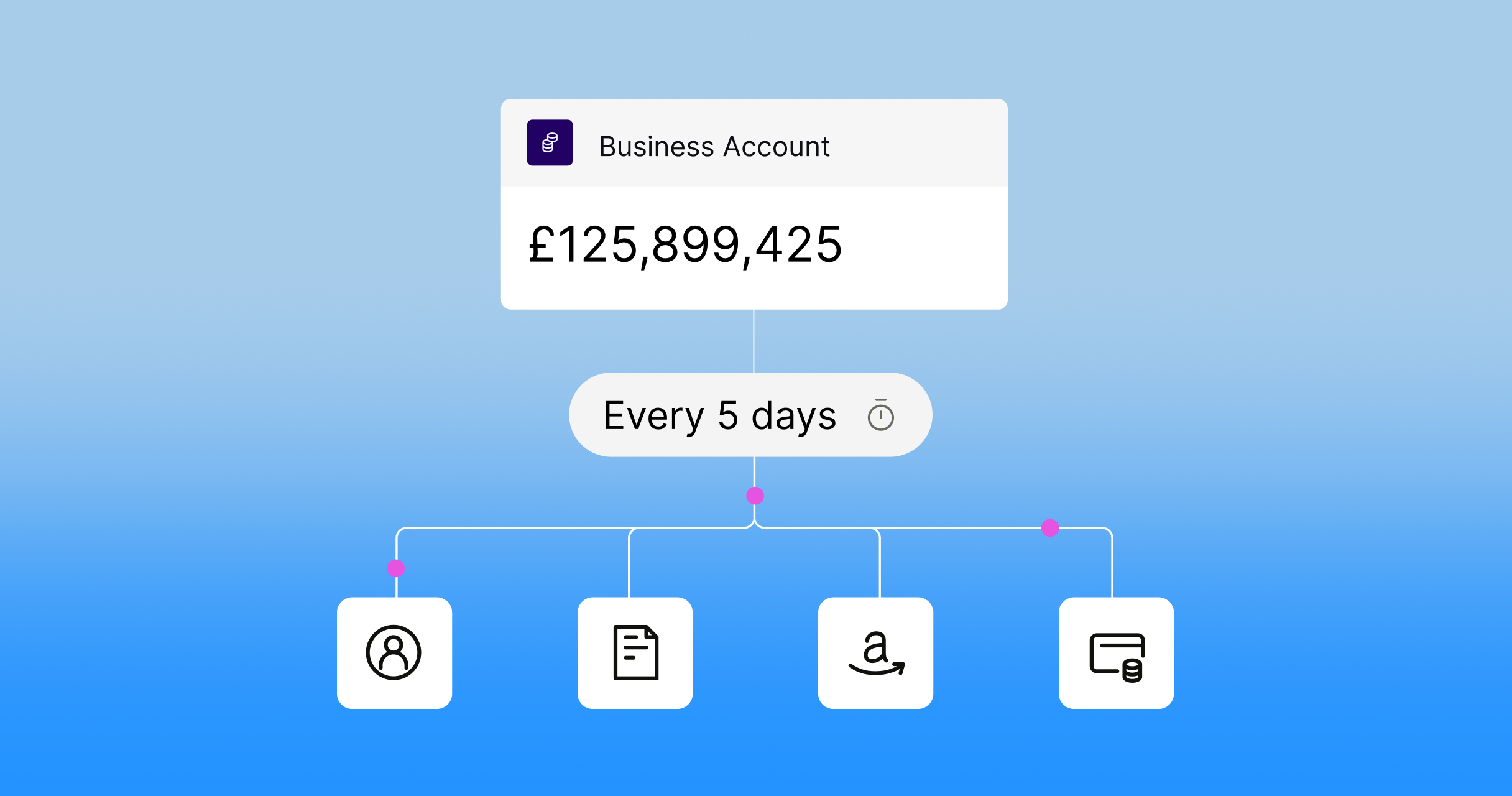
Variable Recurring Payments are the biggest change to how UK businesses move money since Faster Payments. Here is what they are, and what they change for accounts payable.
Variable Recurring Payments, or VRPs, are the most significant change to how UK businesses move money since Faster Payments launched. A VRP is a standing consent that lets a trusted provider take payments from your account within limits you set: a maximum per payment, a maximum per period, and a defined purpose. It runs on open banking rails rather than the card networks or Bacs, which makes it faster, cheaper and far more controllable than the instruments most finance teams rely on today.
For accounts payable, that combination is the point. Most payment methods force a trade-off between control and automation. Manual bank transfers give you control and no automation. Direct Debit gives you automation but hands the mandate to the supplier. VRPs collapse that trade-off: the payer sets the rules once, and payments then run automatically inside them.
How Variable Recurring Payments differ from Direct Debit
Direct Debit, run through Bacs, has been the default for recurring business payments for decades. The mandate sits with the recipient, who decides how much to collect and when. The payer's protection is after the fact, through the Direct Debit Guarantee. A VRP inverts that. The consent is held by the payer and enforced by their bank in real time. A payment that breaches the agreed limit or falls outside the agreed purpose simply does not execute. Settlement is near instant over Faster Payments, so the supplier sees cleared funds in seconds rather than days, and there is no three-day Bacs cycle to plan around.
The Payment Systems Regulator and Pay.UK have driven the rollout in two phases. Sweeping VRPs, which move money between a person's or business's own accounts, are already live. Commercial VRPs, which cover payments to third parties such as suppliers, are the phase that reshapes accounts payable, and they are arriving through 2026 as the industry agrees a common framework and pricing.
Why VRPs matter for accounts payable
The value is not simply cheaper transactions, though lower cost than card acceptance is real. The value is that a VRP makes a payment relationship programmable. A finance team can authorise a supplier for a recurring or usage-based payment, cap the exposure, and let the network handle execution without releasing each payment by hand. That removes the weekly payment run as a manual bottleneck while keeping the payer firmly in control.
It also changes what payment certainty looks like. When a buyer pays a supplier by VRP, the supplier receives confirmation and cleared funds at the same moment. Combine that with observable payment behaviour data across a network, and 'we will pay you in 30 days' starts to give way to a verifiable, real-time record of how a buyer actually pays. That is the shift from a promise about a date to a signal about behaviour.
What VRPs do not solve on their own
A faster, controllable rail does not tell you whether the account you are paying belongs to the supplier you think it does. VRPs move money efficiently, but they do not verify identity or catch a switched bank detail. Authorised push payment fraud works precisely because the payer authorises the transfer. So a VRP consent set up against a compromised account will pay a fraudster faster, not slower.
This is why the rail needs a trust layer above it. Supplier verification confirms the counterparty and their banking details before a consent is granted, and continuous monitoring flags when something changes. Open banking gives you the rail. A connected accounts payable network gives you the assurance that the rail is pointed at the right destination.
Where this leaves UK finance teams
VRPs will not replace every payment method overnight. Bacs and Faster Payments are not going anywhere this year. But the direction is set, and the teams that benefit first will be the ones that have already cleaned up their supplier data and can plug verified counterparties into a new rail with confidence. Treat the next 12 months as preparation: get supplier identity and bank details verified, get payment behaviour visible, and you will be ready to adopt commercial VRPs as a controlled upgrade rather than a leap of faith.
To see how verified supplier data and real-time payment status fit together, read how the network works or explore the supplier network.
.jpg)

.jpg)